PART IGetting to know your Aquarino KH
CHAPTER 1
What the Aquarino KH is
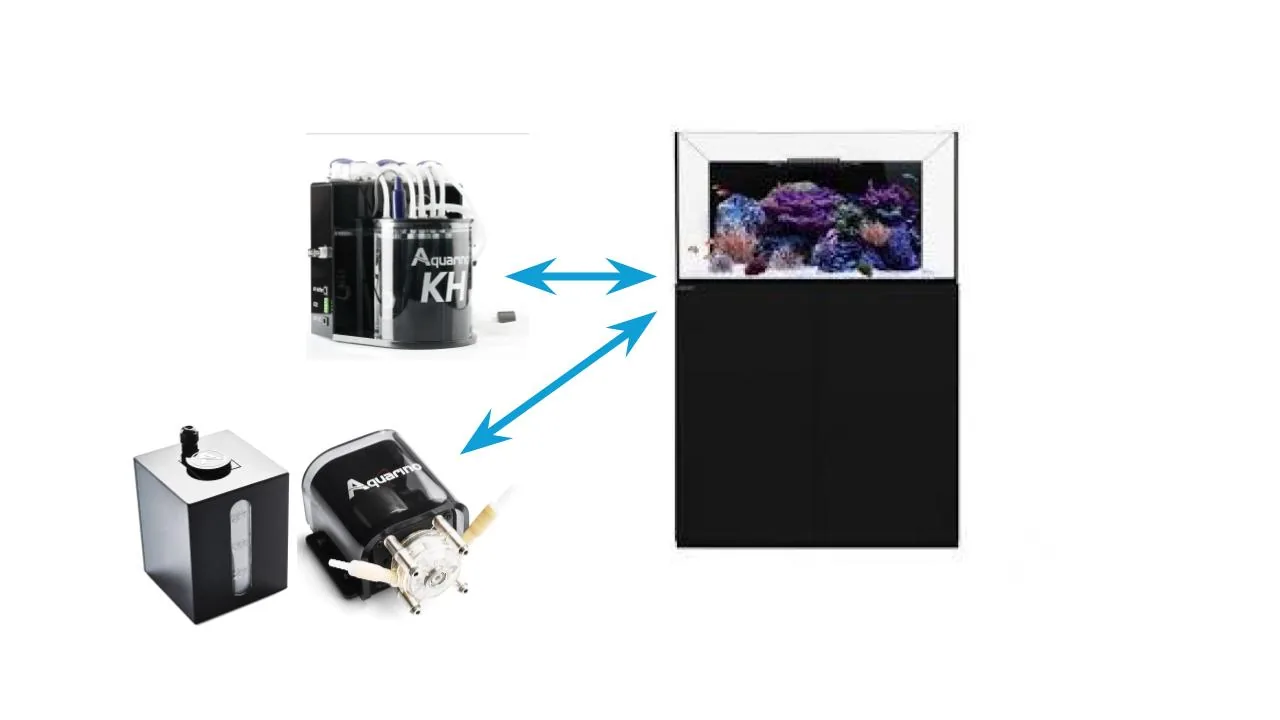
The Aquarino KH is an alkalinity (KH) meter and controller for marine aquariums. It measures your aquarium's alkalinity automatically and continuously — no reagents, no refills and no cost per measurement — and, if you want, corrects the KH on its own within the limits you define.
Instead of a chemical test done whenever you remember, the Aquarino KH gives you a time series: up to 24 measurements a day, all recorded, with graphs, an event log and e-mail alerts.
1.1 What it does
- Measures your aquarium's alkalinity at the interval you set, from 1 to 24 times a day.
- Alerts you when KH leaves the range you consider ideal — by e-mail, by sound alert and through the panel LED.
- Corrects upward, driving an external dosing pump with KH buffer or an _all-in-one_ solution.
- Corrects downward, controlling the CO2 solenoid — or the peristaltic pump — of your calcium reactor.
- Records every measurement, every dose and every decision, with export to a spreadsheet.
- Passes the value on to other equipment, through the KH-OUT port or the Aquarino Controller integration.
1.2 What it does not do
Being clear about the limits of the equipment is part of using it well.
- The Aquarino KH does not replace your replenishment system. It makes small corrections and sustains stability; your balling or calcium reactor is still what replaces the daily consumption.
- It measures and decides on alkalinity alone. Calcium, magnesium and other elements are not measured and play no part in the dosing decision — although they may be replenished alongside, depending on the product you use (see the note below).
- It does not fix an undersized system. If the reactor has run out of CO2 or the balling is underdosed, the Aquarino KH shows the problem clearly in the graph and in the event log, but solving it is up to you.
- It does not replace your chemical test. That test is the anchor of calibration — see Chapter 10.
1.3 Who it is for
| Your system | How the Aquarino KH helps |
|---|---|
| Balling with several dosing pumps | Monitoring and alerts. You adjust your doses with real data instead of guesswork, and still have the buffer doser as a safety net. |
| 3-in-1 balling (single dose) | Automatic correction through the buffer doser. This is the scenario where the equipment comes closest to running on its own. |
| Calcium reactor | Control of the CO2 solenoid through the Co2 Port. You set the bubble counter once and the equipment handles the fine adjustment hour by hour. |
| Aquarium without automatic replenishment | Continuous monitoring and history, so you know when and how much to step in manually. |